The scene is familiar to any parent, educator, or caregiver: a toddler struggling with a stubborn zipper, a primary student frustrated by a difficult math problem, or a teenager facing the sting of a minor social rejection.
In these moments, the instinctive human response is often to step in and solve the problem immediately. We want to smooth the path, remove the obstacle, and restore peace.
However, within that gap—the space between the frustration and the resolution—lies one of the most fertile grounds for a child’s emotional development.
At Rosayo Children Foundation, we view these small, everyday frustrations not as hurdles to be avoided, but as essential building blocks for emotional well-being.
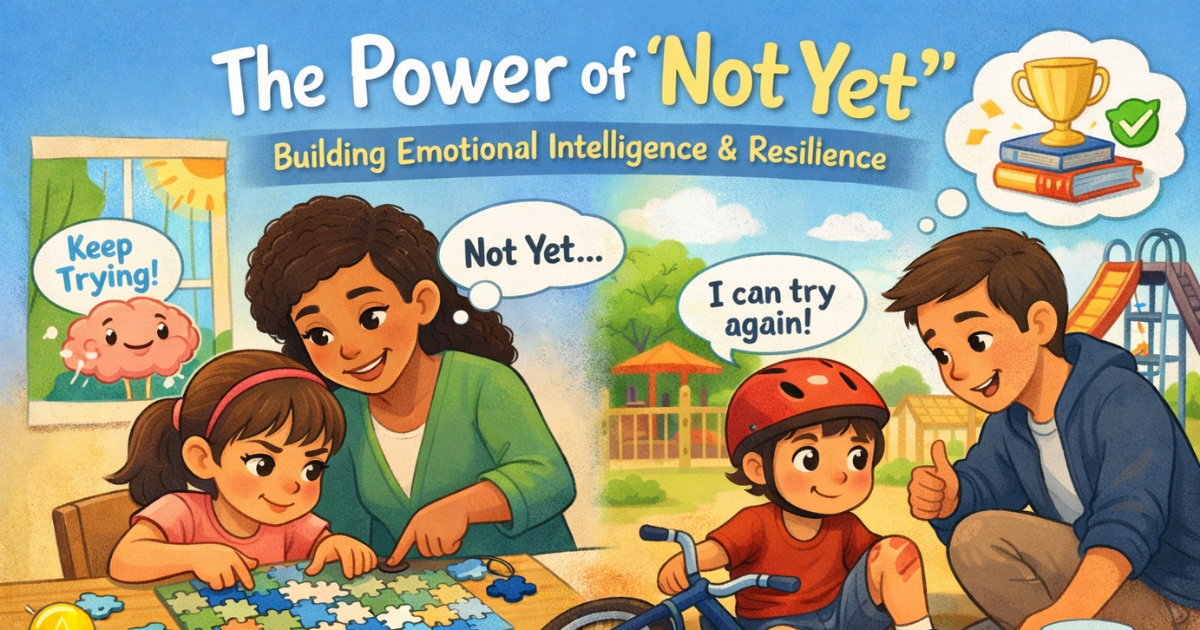
By introducing the concept of “Not Yet,” we can help children transform a moment of defeat into a lesson in resilience and self-regulation.
The Science of Waiting
Emotional intelligence is often discussed in abstract terms, but it is rooted in the very real development of the brain’s prefrontal cortex. This is the area responsible for executive function, impulse control, and the ability to navigate complex social situations.
When a child encounters a frustration they cannot immediately overcome, their brain’s “alarm system”—the amygdala—often triggers a stress response.
For a young child, a broken crayon or a lost game can feel like an emergency. Without the tools to regulate that response, they may resort to outbursts or complete withdrawal.
The “Not Yet” mindset acts as a bridge. It acknowledges the child’s current struggle without labeling it as a permanent failure.
Research suggests that when children are encouraged to view their abilities as something that can grow with effort—a concept known as a growth mindset—they are significantly more likely to persist through challenges rather than crumbling under pressure.
From Frustration to Self-Regulation
Self-regulation is the ability to manage one’s emotions and behavior in accordance with the demands of the situation. It is a skill that must be modeled and practiced, much like reading or riding a bike.
When a caregiver says, “You haven’t mastered this yet, but you are working on it,” they are providing a framework for the child’s internal monologue. This shift in language does three critical things:
- Validates the Emotion: It acknowledges that the task is, in fact, hard.
- Removes the Stigma of Failure: It suggests that “hard” is a temporary state, not a reflection of the child’s worth.
- Encourages Autonomy: It leaves the door open for the child to try again, rather than expecting an adult to take over.
The Impact on the Family Unit
The benefits of building this emotional resilience extend far beyond the child. When children begin to develop self-regulation tools, the “emotional temperature” of the entire household begins to stabilize.
We spoke with Marcus, a primary school educator and community partner, who has seen this shift firsthand in his classroom and through his work with local families.
“I remember a student who would throw his pencil across the room every time he got a word wrong during spelling,” Marcus recalled. “We started working on the ‘Not Yet’ philosophy. Instead of a red ‘X,’ we’d talk about the letters he did get right and say the rest just weren’t there yet. It took time, but the day he got a word wrong, took a breath, and reached for his eraser instead of throwing the pencil… that was a victory for his whole family. His mother told me later that dinner times became calmer because that same patience started showing up at home.”
Marcus’s story reminds us that child development is not a solitary journey. When a child learns to navigate their own frustrations, they are better equipped to show empathy to their siblings and parents, creating a more supportive and compassionate home environment.
A Takeaway for Our Community
As a community, we have a collective role in fostering these supportive environments.
Whether you are a neighbor witnessing a meltdown in a grocery store or a coach on a local sports team, the way we respond to childhood frustration matters. By practicing patience and modeling calm, we send a message to the children around us that it is okay to struggle.
Resilience is not the absence of frustration; it is the capacity to move through it. By embracing the power of “Not Yet,” we are giving children a gift that will serve them for the rest of their lives: the belief that they are capable of overcoming obstacles, one small breath at a time.
Our Perspective
At Rosayo Children Foundation, we are committed to looking beyond basic needs to the heart of what makes a child whole. Supporting a child’s emotional well-being is a long-term investment in our community’s future.
We aren’t just building better students; we are nurturing future leaders who will approach the world’s challenges with the same grit, empathy, and resilience they learned at the kitchen table or in the classroom.
Leave a Reply