Most children circle their birthdays on the calendar with one thing in mind: a party. Cake, balloons, gifts, friends, and a day that feels like it belongs entirely to them.
Birthdays are usually about receiving — and there is nothing wrong with that. Childhood should include joy, celebration, and moments of feeling special.
But every once in a while, a child quietly redefines what a celebration can look like.
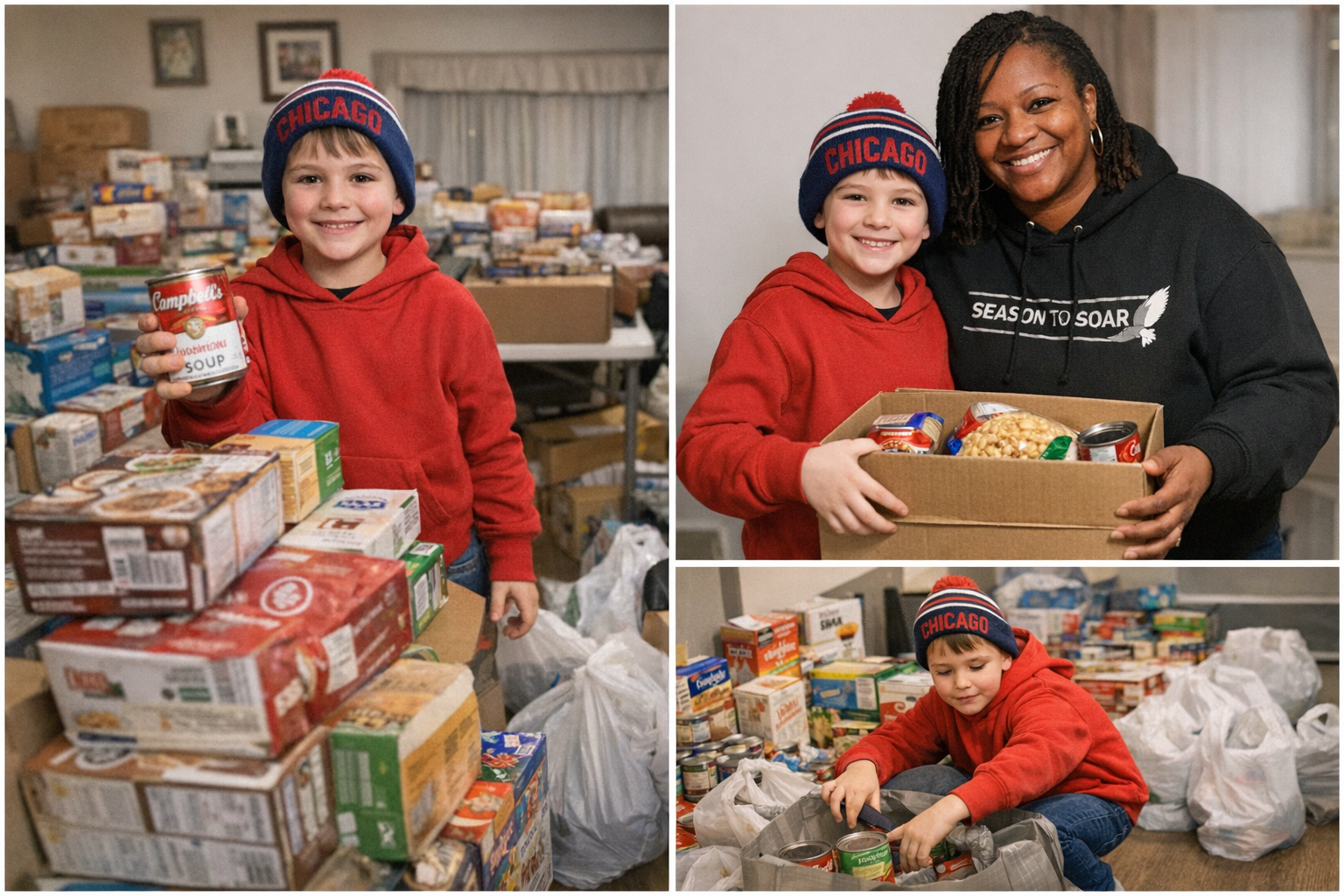
In 2024, eight-year-old Alex Anning from Chicago chose to spend his birthday not throwing a party, but running a food drive. Instead of asking for presents, Alex asked for donations.
Instead of planning games, he helped organize food distribution. By the end of his birthday week, more than 150 families who had recently lost SNAP benefits received support.
It wasn’t a publicity stunt. It wasn’t prompted by pressure. It was a response to something Alex had seen — and something he felt.
When Children Notice What Adults Often Miss
Alex’s decision was inspired by a moment that many people encounter but few stop to reflect on. After seeing a man experiencing homelessness, Alex asked questions.
He noticed discomfort, hunger, and need — and instead of moving on, he stayed curious.
That curiosity mattered.
Children are constantly observing the world around them. They notice injustice before they know the language for it. They feel compassion before they learn how to organize it.
What often determines whether that compassion fades or flourishes is how the adults around them respond.
Alex’s mother, Kymbria Young, chose not to dismiss his concern. Instead, she helped him channel it.
Through her nonprofit organization, Season to Soar, Alex learned that caring feelings can turn into concrete action.
Their home in Tinley Park became a temporary donation hub — filled with food, supplies, and evidence that a child’s empathy can mobilize an entire community.
Turning Compassion Into Action
What makes Alex’s story remarkable isn’t only the number of families served. It’s the process.
Alex didn’t just donate food — he participated. He learned that helping others takes planning, communication, and consistency. He saw firsthand that kindness doesn’t stop at intention; it requires effort.
This is an important lesson for children to learn early.
Too often, kids are taught that generosity is something adults do, charities handle, or governments manage.
Alex’s experience sends a different message: you don’t have to wait to matter.
And that message stayed with him.
Rather than treating the food drive as a one-time birthday activity, Alex decided to make it a yearly tradition.
Each birthday becomes a reminder that growing older can also mean growing more responsible — not just for oneself, but for others.
For his mother, pride comes not only from watching her son help others, but from seeing values take root. Alex is learning that service is not an interruption of life; it is part of it.
What This Story Teaches All of Us
Alex’s story gently challenges the way we think about children and leadership.
We often underestimate what children are capable of — emotionally, socially, and morally. We protect them from complexity, but in doing so, we sometimes shield them from purpose.
Yet children are not too young to understand fairness. They are not too young to recognize suffering. They are not too young to be involved in solutions.
What they need is guidance, trust, and opportunity.
Alex had an adult who listened. He had a structure that allowed him to act. And he had a community willing to support a child-led vision.
That combination is powerful.
How This Aligns With Our Vision for Kids
At Rosayo Children Foundation, we believe stories like Alex’s are not rare accidents — they are examples of what happens when children are raised in environments that value empathy and responsibility.
Our mission goes beyond meeting immediate needs. Yes, we support families through food assistance, education initiatives, and community partnerships.
But at the heart of our work is something deeper: shaping children who understand that they are part of a larger human family.
Through our programs, we aim to:
- Provide stability so children can grow without constant fear or uncertainty
- Encourage literacy and learning through reading circles and enrichment activities
- Create opportunities for children to participate in acts of service
- Model values that children can absorb through experience, not just instruction
We believe children should not only receive help — they should see how help works.
Just as Alex learned generosity by observing it and practicing it, children in our programs learn responsibility by being included, trusted, and guided.
Building a Culture of Compassion
One of the most powerful aspects of Alex’s story is that it didn’t require wealth or perfection. It required awareness.
A food drive doesn’t start with resources — it starts with noticing.
When children grow up in homes and communities where noticing is encouraged, compassion becomes normal. Service becomes familiar. Helping others stops feeling extraordinary and starts feeling necessary.
This is the culture Rosayo seeks to build.
A culture where children understand that stability is not only about what they receive, but also about what they contribute. A culture where generosity is practiced, not just praised.
What Does This Remind Us?
Alex’s birthday reminds us that children are not waiting to become leaders — they already are.
At Rosayo Children Foundation, we are committed to nurturing environments where children can transform empathy into action.
Through food support initiatives, reading and enrichment programs, and community partnerships, we aim to raise children who don’t turn away from need — but respond to it.
Reflection Questions for Families and Caregivers:
- What examples of compassion are children observing in our homes and communities?
- How can we involve children in helping others in age-appropriate ways?
- What traditions of service can we create that last beyond a single event?
We believe that today’s compassion becomes tomorrow’s leadership.
And sometimes, the most meaningful celebrations aren’t marked by gifts received — but by lives touched.
At Rosayo, we remain committed to raising children who understand that even small hands can carry great responsibility — and even greater hope.
Leave a Reply